

Ketamine Part 4: Ketamine’s Collision Course
How Money and the FDA Slow Ketamine’s Potential to Help

Nothing demonstrates a public demand for an item quite like an FDA crackdown on illicit sellers trying to take advantage of that demand.
That’s what happened on July 7, 2026, when the FDA sent out 14 different warning letters to online sites selling non-FDA-approved ketamine for therapeutic purposes.1
It is unquestionably important that people can trust what they put in their bodies. But I think there is a greater story here on which the FDA’s actions comment.
That is, there wouldn’t be sellers trying to bypass the rules if the sellers didn’t see a demand they thought they could make money from. The public demand for ketamine therapy is there and growing.
And unlike many of the health and diet fads out there, ketamine therapy has research and clinical trials to back up that demand, some of which I shared in Part 1.
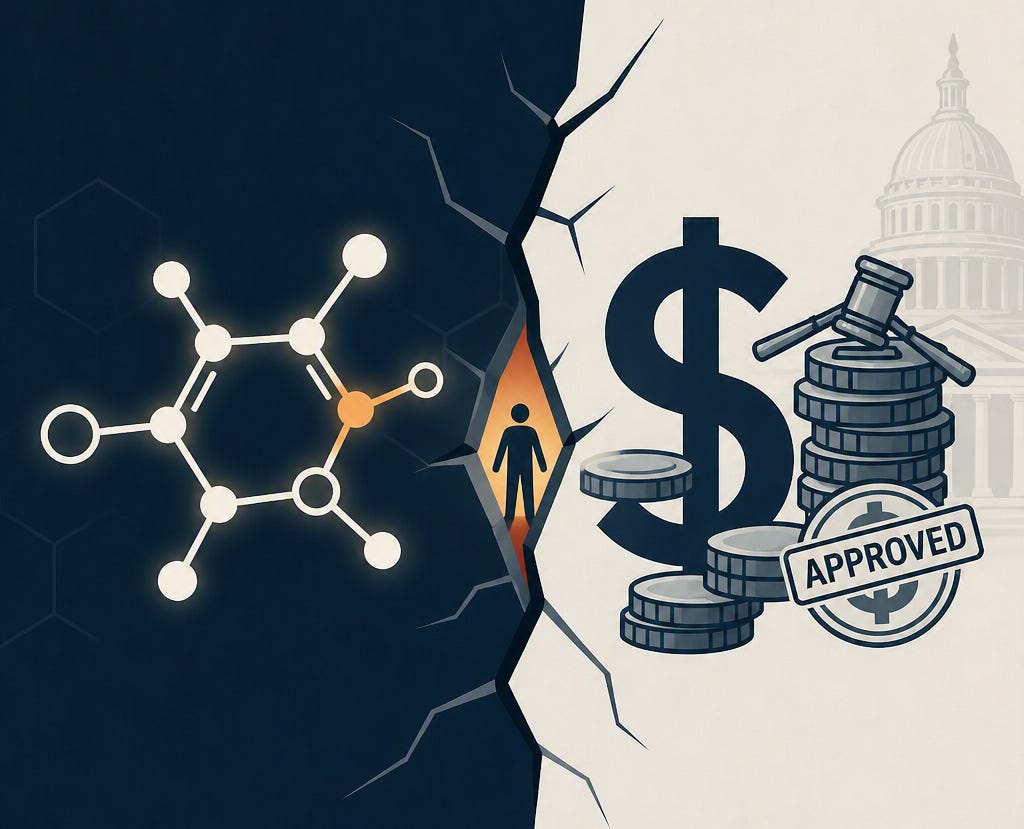
The greater story then is the collision between a critical societal health issue, a growing demand for the promising tool that ketamine could be, governmental regulation, and money.
And since my sessions got canceled this past week due to the clinic’s ketamine provider having a personal emergency, I thought I would share the CliffsNotes version with you.
The FDA’s Partial Action
As I shared in Part 1, ketamine has been FDA-approved for anesthesia during surgery for over 50 years, but only for that purpose.
In 2019, the FDA approved the nasal spray esketamine—a component of the ketamine molecule—for treatment-resistant depression in adults.
I didn’t want to receive esketamine, however, and instead chose to receive generic ketamine through an IV, because a psychiatric nurse I spoke with shared that in his practice he has seen quicker, more lasting improvement in people receiving IV ketamine compared to the nasal spray esketamine.
Others in the space share his same beliefs, though it is not a universal belief among all medical professionals.2
Yet, the FDA has never approved ketamine for any use other than anesthesia.
The Big Pockets of Big Pharma
The picture becomes clear once you know that a pharmaceutical company holds multiple patents for esketamine and sells it under the brand name Spravato®.
On the other hand, ketamine is a generic drug that cannot be patented (i.e., not a money-maker) and thus no company has made the effort to push it through the FDA, though it’s not like the FDA needs a company with money for the FDA to do its job.
The lack of FDA approval, however, doesn’t mean that receiving ketamine for any purpose other than anesthesia is illegal. It can still be legally prescribed by a doctor for off-label use.
But what that difference in FDA approval does mean for the general public is that insurance companies cover Spravato® but not ketamine.
And the insurance companies only cover Spravato® when a doctor prescribes it for treatment-resistant depression, since that is all the FDA has approved it for.
If you don’t have insurance, or you need help with something other than treatment-resistant depression, and you don’t like the idea of an IV? Well, then the total out-of-pocket cost of Spravato® is six times that of ketamine treatment despite having comparable or worse results.3
The U.S. is Anxious
Here’s why the above is important.
According to the Anxiety & Depression Association of America, Generalized Anxiety Disorder affects 6.8 million adults (3.1%) of the U.S. population, but only 43.2% of those people are receiving treatment.4
And that number is only going up because a whopping 31.9% of adolescents between 13 and 18 years old are affected by anxiety disorders.5
With so many people needing help, the barriers to potentially more effective and quicker solutions because no one can make money off it is frustrating.
The more suffering people there are that are aware of what is available to them now, and what could be available to them if progress is made, the greater the existing demand will rise for advancing promising psychedelic treatments and gaining access to them.
And the greater the demand, the more likely someone will figure out how to make money off it and get it in the hands of those who need it.
Because let’s be real. Money will always determine the actions so long as the actions cost money.
Just remember: We can be curious. We can ask the questions to educate ourselves. We can drive progress by having the conversations with others.
Take Care of Yourself,
Alex
Feel like you could benefit from coaching? I’m offering 5 free 45-minute sessions to two more clients. Message me for more details.
Enjoyed the article? Let me know by liking or sharing so I can write more like it. And subscribe if you haven’t already!
Annabel Kartal Allen, FDA cracks down on illegal ketamine sellers amid nearing ‘psychedelic revolution’, Pharmaceutical Technology, July 8, 2026, https://www.pharmaceutical-technology.com/news/fda-cracks-down-on-illicit-ketamine-trade/?cf-view
Study: Intravenous Ketamine Vs. Intranasal Esketamine, https://www.psychiatrist.com/news/study-intravenous-ketamine-vs-intranasal-esketamine/.
Id.
Anxiety Disorder Facts & Statistics, Anxiety & Depression Association of America, https://adaa.org/understanding-anxiety/facts-statistics.
Id.