
#13 Stop Being Controlled by Your Own Brain
The Patterns You Can't See Are Running Your Life

Author’s Note: In the last article #12 Are You What You Think, I referred to the distinction between involuntary thoughts and voluntary self-talk. Upon further reflection while writing this article, I think it better to consider the distinction to be between involuntary thoughts and voluntary thoughts because we can voluntarily think of an image or another non-word thought. In this sense, voluntary thoughts include voluntary self-talk. This article was written with the updated distinction in mind.
You’re scrolling social media when a friend posts about their promotion. Immediately, the thought they’re doing better than me appears, followed by a sinking feeling in your stomach, and now you’re annoyed at yourself for feeling jealous. Welcome to your interconnected system.
Like a wad of cables that can never be untangled, your emotions, feelings, and involuntary thoughts are all deeply intertwined. They form an interconnected system where each type of signal can set others in motion, all working together as your brain’s attempt to help you navigate your world.
An involuntary thought can spark an emotion, feeling, or another involuntary thought. Immediately thinking they’re doing better than me may have sparked the sinking feeling in your stomach.
An emotion can summon a feeling, involuntary thought, or another emotion. Maybe you feel sad after a difficult conversation with someone you care about, and suddenly thoughts appear like nobody really understands me or I’m always the one who gets hurt.
A feeling can trigger an involuntary thought, emotion, or another feeling. You may have been fine an hour ago, but your familiar headache pain arose and now you’re in an irritable mood.
This is your interconnected system at work—signals constantly triggering other signals in an endless feedback loop.
Your voluntary thoughts—such as the self-talk you consciously choose—can play into this interconnected system as well, both as trigger and response. An involuntary thought, emotion, or feeling may either trigger your own commentary or be triggered by it.
For example, you might feel anxious about a date and say to yourself calm down, there’s no reason to be anxious, which triggers additional anxiety about feeling anxious when, apparently, there is no reason for you to be.
All this matters because understanding and paying attention to your interconnected system of emotions, feelings, and involuntary thoughts—and what sets it in motion—helps you learn about yourself. It helps you figure out how your brain is presently programmed. And that self-knowledge is the difference between being controlled by your brain’s programming and learning to work with it.
So how do you actually learn about your brain’s programming?
By watching for patterns.
Recognizing Your Patterns
A pattern is a recurring emotional response, thought, feeling, or behavior that arises over time in reaction to a similar stimulus, situation, or internal trigger.
Your patterns could be entirely contained within your interconnected system—involving only your own emotions, feelings, and involuntary thoughts.
Do depressive emotions always follow certain thoughts that pop up? Each time you recognize that you feel happy, does your body tighten up or does a sense of foreboding emerge? When you feel disappointed, do involuntary thoughts typically appear that are critical of yourself?
Your patterns could also involve factors outside your body that trigger your interconnected system.
Does being in certain environments usually elicit the same feelings or emotional response in you? When something doesn’t go how you wanted it to, does your self-talk get cynical, and then your mood turns cynical? Do at least some people tend to react to you in similar ways or say similar things to you?
All these recurring sequences are your brain showing you its programming or are evidence of the same.
Once you spot a pattern, what you do with it depends on the pattern itself.
What to Do With Your Patterns
The patterns themselves don’t necessarily tell you the specifics of your brain’s programming. But that doesn’t always matter. Sometimes recognizing the pattern is enough.
When you become aware that your self-talk tends to get cynical after something doesn’t go right, it might not matter what the cynicism is specifically trying to protect you from. Acknowledging the pattern may be enough on its own for you to help yourself by changing your self-talk and avoiding the cynical mood.
Other times, recognizing the pattern might not be enough. It might not give you anything actionable you can do, so the pattern keeps happening. When this is the case, it may help to try deciphering what the pattern means.
For example, noticing that your body tightens up each time you become aware that you’re feeling happy doesn’t mean you can now simply tell your body to stop tightening up. It’s an automatic emotional response. You could learn techniques to help your body release its tightness, but that tightness may remain a recurring visitor.
Maybe, however, you’re able to decipher that the pattern could mean your brain has been programmed to fear that you will mess up your happiness or to fear when happiness runs out generally.
And maybe that fear response is for you to grip tightly to happiness when you have it, your brain associating gripping tightly with tightening your muscles.
Understanding your brain’s programming at this depth may allow you to work on improving your relationship with yourself or with happiness. This work, in turn, could lessen your fear response and lessen the tightness you feel.
But getting to that understanding isn’t easy.
Deciphering your brain’s programming from your patterns is difficult work. You may very well need the help of a mental health professional to get there, at least at first. From your conversations with them, a professional might also recognize a pattern over time that you had not.
Years ago, for me personally, I would far too often receive comments from different friends that I was always complaining. It would irritate the hell out of me because I didn’t think that I was. It felt to me like I was just making statements in conversation. But the pattern was clearly there.
I started trying to avoid saying things that could be construed as complaining. And I’d say I got better at it. But I still did and the compulsion to complain didn’t go away.
It wasn’t until later, after reading about perfectionism and talking about it with a therapist, that I was able to look at the pattern and recognize the complaining for what it was—a coping mechanism to release the anxiety I felt about things not being perfect and what that would mean for me.
By improving my relationship with myself, I began to release perfectionism’s grip and the need for that release diminished. The pattern didn’t disappear overnight, but understanding what it meant gave me something actionable to work on.
So you learn your patterns. You decipher your programming. You gain this deeper self-knowledge. And maybe over time your emotional responses change.
But what does this actually do for you in daily life?
It’s the difference between being at the mercy of your brain’s programming and being able to work with it.
Working with Your Brain’s Programming
Here’s what that actually looks like.
At first, you’ll likely recognize a pattern after the fact. You’ll notice three hours later that the tightness in your chest showed up right when you told yourself you weren’t good enough. Or you’ll realize the next day that your irritable mood started when that familiar headache crept in.
That’s fine. That’s normal. Recognizing patterns after they’ve already played out is how you start to map your brain’s programming.
The goal, however, is to eventually catch these patterns in real time.
When you can see the pattern as it’s happening—when you recognize that sinking feeling in your stomach while the critical self-talk begins, when you notice your body tensing as the anxiety starts to rise—something shifts.
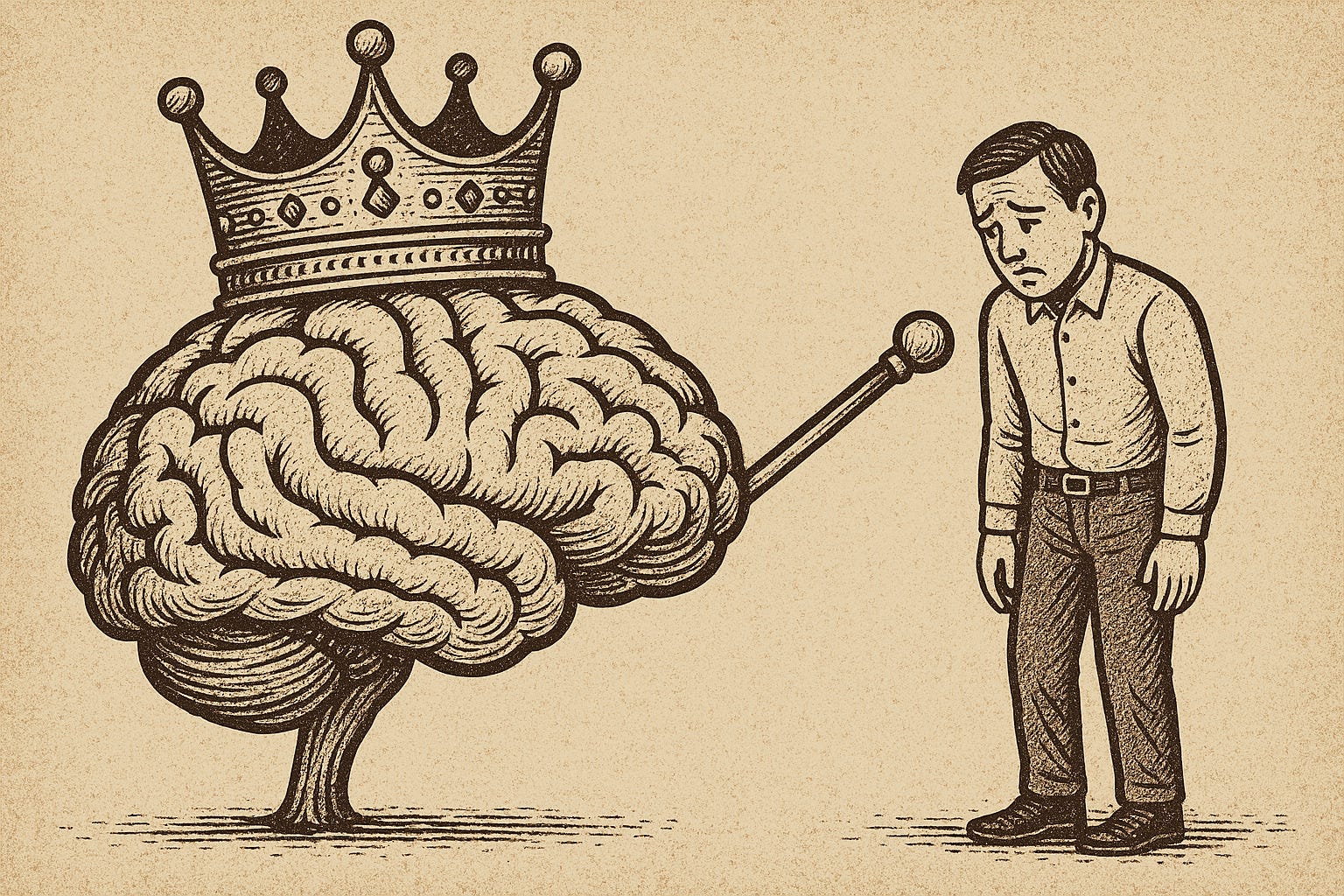
The emotions or feelings don’t just hit you and sweep you away. You’re not a marionette controlled by the strings of your brain’s programming, jerking automatically in response to each pull. Instead, you see what’s happening as it unfolds.
And seeing it creates space.
Space to pause. Space to choose. Space to respond differently than the pattern would have you respond.
Maybe you still feel anxious, but instead of spiraling into more anxiety about feeling anxious, you recognize the pattern and decide to accept that you will feel anxious until you no longer do. Maybe the critical thoughts still appear, but you don’t automatically believe them or build your actions around them.
This is what makes understanding your brain’s programming practical. It’s not about eliminating your patterns entirely or perfectly controlling your emotions. It’s about creating enough awareness that you’re no longer on autopilot.
You become someone who can feel the pull of the pattern and still choose your response. Someone who knows themselves well enough to work with their brain’s programming instead of being controlled by it.
That’s the difference knowing yourself at an emotional level makes. The patterns don’t control you anymore—you work with them. And that changes your ability to direct your life how you want to, not how you were taught to.
Take Care of Yourself,
Alex
Do Selfish Well is a reader-supported publication. Thank you for reading. If you would like to help support the growth of Do Selfish Well and its message to reach more people, you can:
Tap the “like” button if this article made you think
Tap the “restack” button or “share” the article on social media if you think this article might make others think
Leave a comment if you are open to sharing what the article made you think about
Head to the archives if you want to learn more
Subscribe or follow if you want to stay in the loop for the next article and new developments
This was a clear explanation of something that usually feels abstract. The idea that noticing creates space stayed with me.
Solid breakdown of metacognition in practice. The shift from recognizing patterns after-the-fact to catching them in real time is where the real work happens, but there's an almost paradoxical challenge there: observing the pattern while simultaneously being in it requires a kind of mental split-screen that takes ages to develop. I've found journaling right after a pattern fires helps me shorten the gap between occurence and recognition over time.